Sophia-Antipolis. Europe's first technology park.
A short tribute to a remarkable place — and to the visionary who imagined it. How a deserted plateau above Antibes became the prime science and technology park of Europe, and one of the most international places to study and work in France.
The father of Sophia-Antipolis
And still its largest today
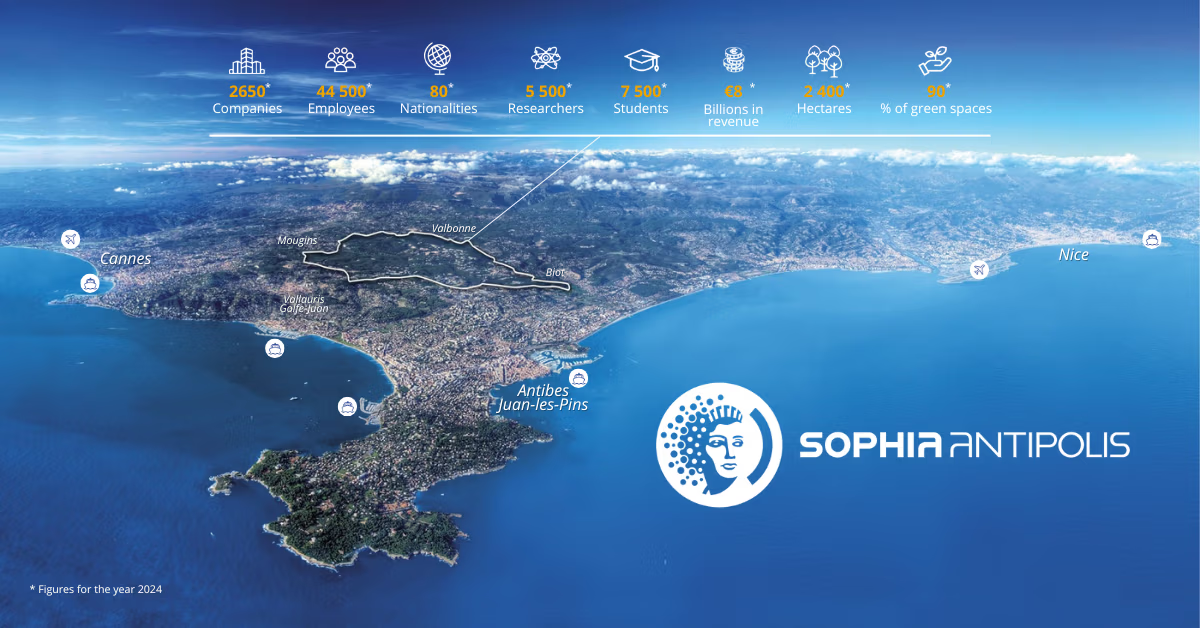
Between Nice, Antibes & Cannes
Pierre Laffitte, the man who dreamed it into being.
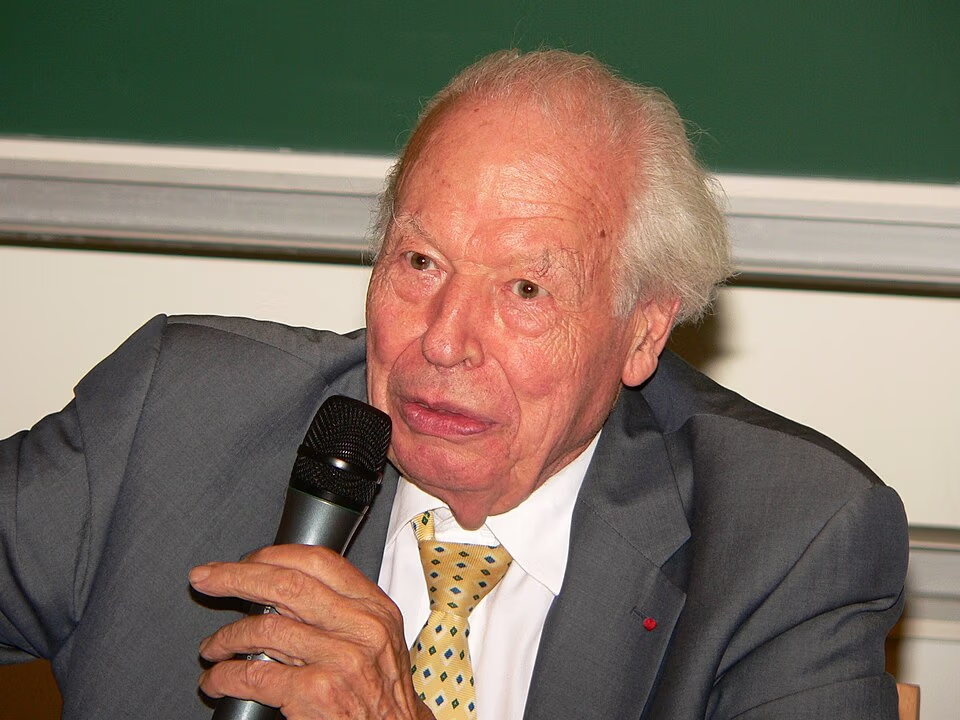
A child of the Riviera who became a builder of the future.
A graduate of the École Polytechnique and an engineer of the Corps des Mines, Laffitte was a geologist, then director of the École des Mines de Paris, then a Senator of the Alpes-Maritimes for more than two decades. Above all, he was the tireless visionary behind the first technopole of Europe.
« A Latin Quarter in the fields. »
An idea, in print
In an August 1960 article in Le Monde, Laffitte called for a « Quartier Latin aux champs » — lifting the scattered brainpower of Paris and replanting it, concentrated, in the open countryside of the South.
A Florence for the 21st century
He imagined an international city of wisdom, science and the arts — a place where minds would meet by design, in a beautiful natural setting, far from bureaucratic gravity.
Sophia · Antipolis
Sophia after his wife Sophie — and, fittingly, the Greek word for wisdom. Antipolis is the ancient Greek name of nearby Antibes. Wisdom, beside the sea.
In 1969, on a deserted plateau in Valbonne, the dream became a worksite.
What Paris had greeted with some irony, Laffitte made real — the founding act of the science-park model in France, and the template that the rest of Europe would follow.
It began with the École des Mines de Paris.
École des Mines de Paris
Founded in 1783, it is one of the most prestigious industrial-engineering grandes écoles in France — a school whose engineers have shaped French industry for two centuries.
The director who looked south
Laffitte was deputy director and then director of the school (until 1984). He pioneered research carried out hand-in-hand with industry — and chose Sophia for one of its centres.
« The École des Mines is the mother of Sophia-Antipolis. »
When the park opened in 1969, the École des Mines was among its very first occupants. Planting a campus of a great engineering school in an empty garrigue was the spark — the credibility and the gravity that pulled in everyone who followed. Its materials and applied-mathematics centres still anchor the park today.
Cross-fertilisation: minds that meet on purpose.
Disciplines deliberately mixed
Researchers, entrepreneurs and engineers from different fields, placed side by side so that ideas spill across boundaries — the chemistry Laffitte called cross-fertilisation.
A community, not just an estate
Shared squares, cafes and footpaths through the woods. Sophia was designed so that people who would never otherwise meet, do — over coffee, on a trail, between buildings.
Technology inside a forest
From 1969, environmental care was a founding rule. Two-thirds of the park stays green; buildings are kept low and woven into the landscape rather than imposed on it.
Technology should elevate people, not replace them.
Half a century on, that human-centred idea still governs the place: wisdom (« Sophia ») at the centre, technology in service of it.
Still, today, the prime science park of Europe.
Mature, but not old.
Sophia is less famous now than it deserves to be — yet it remains Europe's first and leading science and technology park, still creating around a thousand new jobs a year in AI, microelectronics, biotech and connected vehicles.
Deeply international — and it speaks English.
Sophia has drawn talent from every continent for over fifty years. Across 80+ nationalities, the common working language of the park is English — the thread that ties together the cultures, companies and laboratories gathered here.
A genuinely international place to study and to work.
You can build a serious technology career here without French as a prerequisite — while living on the Côte d'Azur and learning French if you choose. Few places in Europe combine that openness with this quality of life.
Global names — and the place one of them was born.

Amadeus was born here in 1987 — and never left.
Founded in Sophia by Air France, Lufthansa, Iberia and SAS, Amadeus grew into a world leader in travel technology, with thousands of engineers still on the plateau. Around it: Orange, Thales, Renault, Arm, SAP, NXP, Infineon, Bosch, Accenture, IBM and the European host of the W3C, among 2,500 others.
Our campus sits inside one of Sophia's landmark buildings.
From a computing giant's R&D centre to DSTI.
Built in the 1980s by Digital Equipment Corporation (DEC), it was a major advanced research site for one of the most successful computer companies of its era, gathering engineers and scientists from around the world — a fitting embodiment of Sophia's international, cross-fertilising spirit.
DEC was acquired by Compaq, which was in turn acquired by Hewlett-Packard — and for years it was known simply as « the HP building », shared at times with teams from Amadeus. When HP split into HPE and HP Inc. in 2015, the building was sold and became a multi-occupancy space, now called Templiers Valley.

Where standards are set and talent is trained.
Inria · CNRS
National institutes for digital science and fundamental research sit at the core of the park's laboratories.
Université Côte d'Azur · MINES Paris · EURECOM · SKEMA · DSTI
A full campus ecosystem — engineering, computer science, management — feeding the park its graduates.
ETSI · W3C
ETSI, based in Sophia, sets the telecom standards behind GSM and modern mobile networks; Europe's W3C host helps shape the standards of the Web itself.
An extraordinary place to study and to work.
A garrigue became a city of wisdom.
One man's idea, fifty years of proof.
- A Latin Quarter in the fields — built, and still working.
- Cross-fertilisation as a living method, not a slogan.
- Europe's first science park, and its enduring leader.
- A genuinely international home for talent and ideas.
It deserves to be far better known than it is — and it remains one of the finest places in Europe to build a future in technology.
Presented with gratitude — to a place, and to a friend of my family.
For Pierre Laffitte, 1925–2021: friend of my grandparents, builder of Sophia, and one of the great visionaries of the Côte d'Azur.
Sébastien Corniglion
CEO & Dean, DSTI School of Engineering — Sophia-Antipolis & Paris
dsti.school